JavaScript Full-Stack Developer Roadmap 2026
Step-by-Step Guide from Beginner to AI-Integrated Full-Stack Pro — Job-Ready in 6–12 Months
In 2026, JavaScript continues to dominate web development as the most used programming language for the 13th consecutive year — used by over 66% of all developers worldwide. React powers 44.7% of developer projects. Node.js runs the backend of millions of apps. Next.js ties the whole stack together. If you want to become a full-stack developer, JavaScript is the smartest path to take.
This roadmap gives you a clear, realistic, and project-based path from writing your very first line of HTML to deploying AI-powered full-stack applications — all using one language: JavaScript. Follow this 6–12 month plan and you will be job-ready with a strong portfolio.
Table of Contents
- Salaries and Job Market in 2026
- Which JavaScript Stack to Choose
- Phase 1 — Foundations (Months 1–2)
- Phase 2 — Core JavaScript (Months 2–3)
- Phase 3 — Frontend with React (Months 3–5)
- Phase 4 — Backend with Node.js (Months 5–7)
- Phase 5 — Full-Stack Integration and Mobile (Months 7–9)
- Phase 6 — AI Integration (Months 9–10)
- Phase 7 — DevOps and Deployment (Months 10–11)
- Phase 8 — Career Building (Month 12+)
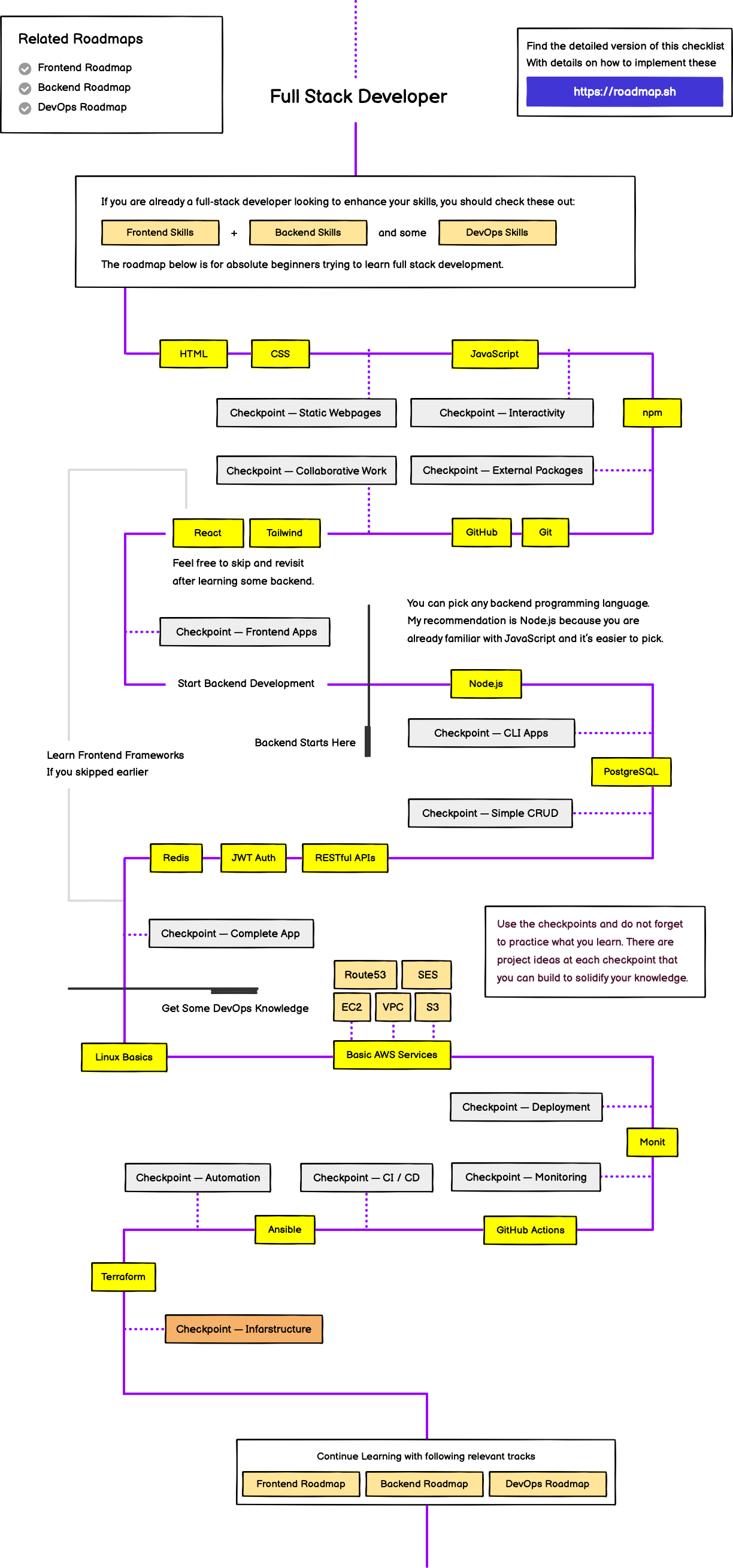
Visual overview of the full-stack developer journey — from HTML basics to cloud deployment
Salaries and Job Market in 2026
Before starting any learning journey, it helps to know what you are working toward. Here are the average annual salaries for JavaScript full-stack developers in 2026:
Which JavaScript Stack to Choose in 2026
There are several popular JavaScript stacks in 2026. Here is a clear comparison so you can choose the right one for your goals:
| Stack | Technologies | Best For | Difficulty |
|---|---|---|---|
| MERN | MongoDB, Express, React, Node.js | Startups, APIs, SPAs | ⭐⭐⭐ Medium |
| Next.js Stack | Next.js, TypeScript, Tailwind, Prisma, Supabase | Production apps, SEO, 2026 jobs | ⭐⭐⭐⭐ Medium-High |
| T3 Stack | Next.js, tRPC, TypeScript, Tailwind, Prisma | Type-safe full-stack apps | ⭐⭐⭐⭐⭐ Advanced |
| MEAN | MongoDB, Express, Angular, Node.js | Enterprise apps | ⭐⭐⭐ Medium |
1 Phase 1 — Foundations (Months 1–2)
Every full-stack developer starts here. Before touching any framework, you must understand how the web works. This phase builds the foundation that everything else sits on top of.
Best Free Learning Resources
2 Phase 2 — Core JavaScript (Months 2–3)
JavaScript is the engine of your entire full-stack career. This phase is the most important one. Do not rush through it. Spend at least 3–4 weeks here and make sure you truly understand why the language behaves the way it does — this will save you months of confusion later.
Key JavaScript Concepts Every Developer Must Know
// Async/Await — the most important JS concept for full-stack dev
async function fetchUserData(userId) {
  try {
    const response = await fetch(`https://api.example.com/users/${userId}`);
    if (!response.ok) throw new Error(`HTTP error: ${response.status}`);
    const user = await response.json();
    return user;
  } catch (error) {
    console.error('Failed to fetch user:', error.message);
  }
}

// Destructuring — used everywhere in React
const { name, age, email } = user;
const [first, ...rest] = items;
Best Learning Resources
3 Phase 3 — Frontend with React (Months 3–5)
React is the most popular frontend library in 2026, powering 44.7% of developer projects. Learning React will open more doors than any other frontend skill. In this phase you go from React basics all the way to professional-level state management and performance optimization.
React Component Example — Best Practices
import { useState, useEffect, useCallback } from 'react';

// Clean functional component with hooks
function ProductList({ categoryId }) {
  const [products, setProducts] = useState([]);
  const [loading, setLoading] = useState(true);

  const fetchProducts = useCallback(async () => {
    try {
      const res = await fetch(`/api/products?category=${categoryId}`);
      const data = await res.json();
      setProducts(data);
    } catch (err) {
      console.error('Error loading products:', err);
    } finally {
      setLoading(false);
    }
  }, [categoryId]);

  useEffect(() => {
    fetchProducts();
  }, [fetchProducts]);

  if (loading) return <p>Loading products...</p>;

  return (
    <ul>
      {products.map(product => (
        <li key={product.id}>{product.name} — ${product.price}</li>
      ))}
    </ul>
  );
}
Best Learning Resources
4 Phase 4 — Backend with Node.js (Months 5–7)
This phase is where you go from frontend developer to full-stack developer. Node.js lets you use JavaScript on the server, meaning you use the same language for both frontend and backend — a huge advantage over other stacks.
Express REST API Example
const express = require('express');
const jwt = require('jsonwebtoken');
const router = express.Router();

// Middleware to verify JWT token
const authenticateToken = (req, res, next) => {
  const token = req.headers['authorization']?.split(' ')[1];
  if (!token) return res.status(401).json({ error: 'Access denied' });

  jwt.verify(token, process.env.JWT_SECRET, (err, user) => {
    if (err) return res.status(403).json({ error: 'Invalid token' });
    req.user = user;
    next();
  });
};

// Protected route example
router.get('/profile', authenticateToken, async (req, res) => {
  try {
    const user = await User.findById(req.user.id).select('-password');
    res.json(user);
  } catch (error) {
    res.status(500).json({ error: 'Server error' });
  }
});
Best Learning Resources
5 Phase 5 — Full-Stack Integration and Mobile (Months 7–9)
Now you connect your frontend and backend into a complete working application. You also extend your skills to mobile development using React Native — which uses the same React skills you already have.
Best Learning Resources
6 Phase 6 — AI Integration (Months 9–10)
In 2026, developers who can integrate AI into their applications are 2–3x more productive and significantly more hireable. This does not mean you need to build AI models — it means you learn to use existing AI APIs inside your JavaScript apps.
OpenAI API Integration Example
import OpenAI from 'openai';

const openai = new OpenAI({ apiKey: process.env.OPENAI_API_KEY });

// Express route that uses OpenAI GPT
app.post('/api/chat', async (req, res) => {
  const { message } = req.body;

  try {
    const completion = await openai.chat.completions.create({
      model: 'gpt-4o',
      messages: [
        { role: 'system', content: 'You are a helpful assistant.' },
        { role: 'user', content: message }
      ],
    });

    const reply = completion.choices[0].message.content;
    res.json({ reply });
  } catch (error) {
    res.status(500).json({ error: 'AI request failed' });
  }
});7 Phase 7 — DevOps and Deployment (Months 10–11)
Knowing how to build an app is not enough — you need to know how to ship it to the real world. This phase teaches you to deploy, monitor, and maintain production-ready applications.
8 Phase 8 — Career Building (Month 12+)
Technical skills get you to the interview. This phase gets you the job. Polish your profile, build your portfolio, and learn how to present yourself as a professional developer.
Final Thoughts
This 2026 roadmap combines JavaScript's power across the full stack with the emerging AI skills that separate average developers from exceptional ones. The path is clear — but the key variable is how consistently you build real projects alongside your learning.
Remember: consistency beats perfection. Dedicate 10–15 hours per week, build something after every phase, push it to GitHub, and deploy it live. In under a year, you will have the skills, the portfolio, and the confidence to land your first full-stack job or freelance client.
Comments
Post a Comment